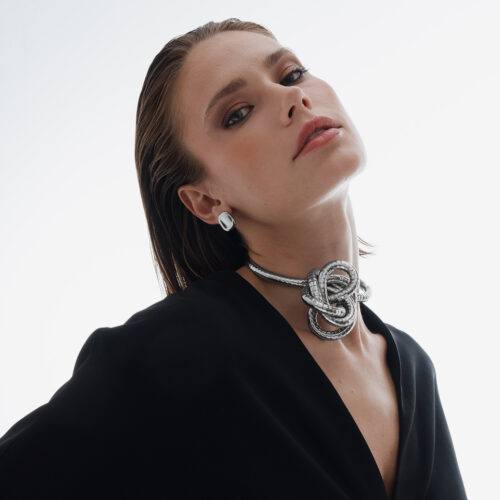



Steel is the matter that more than any other tells the BREIL identity.
Strong, bright, contemporary. It’s not just a technical material, but a true choice of style: the starting point from which jewelry and watches designed to be worn every day, not simply stored, are born.
In the BREIL world, steel becomes language. It transforms into shiny, satin, brushed, faceted surfaces. It captures the light, accompanies the movement, gives character to every detail. It is solid matter, but never rigid. Essential, but never anonymous.
Because BREIL steel is not just steel.
It’s design to wear.
What is BREIL steel?
BREIL steel is 316L stainless steel, an alloy selected to combine strength, stability, aesthetic quality and comfort in everyday wear.
It is a widely used material in the world of watchmaking and jewelry because it resists corrosion, oxidation, humidity, sweat, and the normal stresses of everyday life well.
But for BREIL the 316L is not just a functional choice. It’s a creative subject. A metal to be designed, shaped, polished, sculpted. A material that, in the hands of design, becomes identity.
Are stainless steel and stainless steel the same thing?
Yes. Stainless steel and stainless steel indicate the same family of materials.
“Inox” is simply short for “stainless”. The real difference is therefore not between stainless steel and stainless steel, but between the different types of steel.
Not all steels are the same. Each alloy has specific characteristics in terms of strength, workability, stability and aesthetic yield. BREIL uses 316L steel because it offers an ideal balance for contemporary jewelry and watches: beautiful to look at, pleasant to wear, durable over time


Pso BREIL chooses 316L steel?
BREIL chooses 316L steel because it is a material consistent with the way the brand interprets the design: strong, recognizable, everyday.
Steel 316L:
- it is resistant to corrosion and oxidation;
- maintains its characteristics over time;
- it is suitable for prolonged contact with the skin;
- has a nickel-containing release;
- retains its natural color;
- can be worked with glossy, satin, brushed or faceted finishes;
- resists daily use well.
The letter L in the acronym 316L means Low Carbon, meaning low carbon content. This feature contributes to the stability of the alloy and the quality of the workmanship.
The result is a technical material, but capable of expressing style. A solid foundation on which to build jewelry and watches with a strong character.
Is BREIL steel suitable for leather?
BREIL 316L steel jewelry is designed to reduce the risk of sensitization during normal use and is designed to be worn even in prolonged contact with the skin.
It is important to use correct language: 316L steel is not completely nickel-free. Nickel is present in the alloy composition and contributes to its stability and strength.
What matters, for skin contact, is above all the amount of nickel that can be released during use. For this reason, it is more correct to speak of steel with a nickel-containing release.
The definition “hypoallergenic” does not absolutely exclude a possible individual reaction, but tells of a precise choice: to use a stable, controlled alloy suitable for everyday wear.
Does BREIL steel change color?
BREIL natural steel does not change color like a paint applied to the surface.
Its hue belongs to matter itself. For this reason, natural 316L steel does not peel off and lose color as could happen with a simple surface coloring.
Over time, however, creams, perfumes, soaps, sweat, salt, or residue on the skin can settle to the surface and make the jewelry temporarily dimmer. In most cases, a gentle cleaning with a soft cloth allows you to regain the original shine.
Resistant does not mean without care.
It means designed to live more.

Can you wear BREIL steel every day?
Yes. BREIL 316L steel jewelry and watches are designed for everyday use.
They can accompany everyday life, work, leisure, travel, evenings, the simplest gestures. They are accessories to be lived in, not to be kept in a drawer.
Contact with seawater can also be addressed during normal use, when this characteristic is expected for the product. After the sea, however, it is always advisable to rinse the jewel with fresh water and dry it with a soft cloth, to remove salt, sand and residue.
For products with pearls, stones, leather, crystals, colored parts or special finishes, it is always best to check the indications of the individual product sheet.
Does BREIL steel scratch?
No metal actually worn is completely immune to contact with hard or abrasive surfaces. BREIL steel can also develop small surface marks over time.
This does not mean that the product is of poor quality. It means it was lived.
316L steel offers high resistance to everyday use and retains structure, functionality and identity even over time. Normal surface scratches do not compromise the quality of the material.
For BREIL, resistance is not the absolute absence of signs. It is the ability to maintain character even through use.
A perfect jewel can remain intact.
A lived jewel tells a story.
Why does BREIL steel reflect light differently?
The shine of a BREIL piece of jewelry or watch depends not only on the material, but on how the surface is designed.
A tighter curve, a facet, a concave volume, the alternation between shiny and satin parts: every detail changes the way light meets steel.
BREIL know-how also lies here: not just polishing metal, but drawing reflections, depth and movement.
Thus the steel changes according to the light, the gesture and the person wearing it.
Brilliance is not an added effect.
It’s part of the project.
Steel and Italian Design
BREIL steel takes shape through a creative and design process developed in Milan.
Concepts, proportions, surfaces, details and prototypes are born here. Each collection starts from an Italian vision of design: combining aesthetics, functionality, quality and attention to detail.
Steel is the starting point.
Design is what makes it BREIL.
For this reason BREIL steel is much more than a material. It’s a signature. A presence. A contemporary way of interpreting force.
We are made of steel.